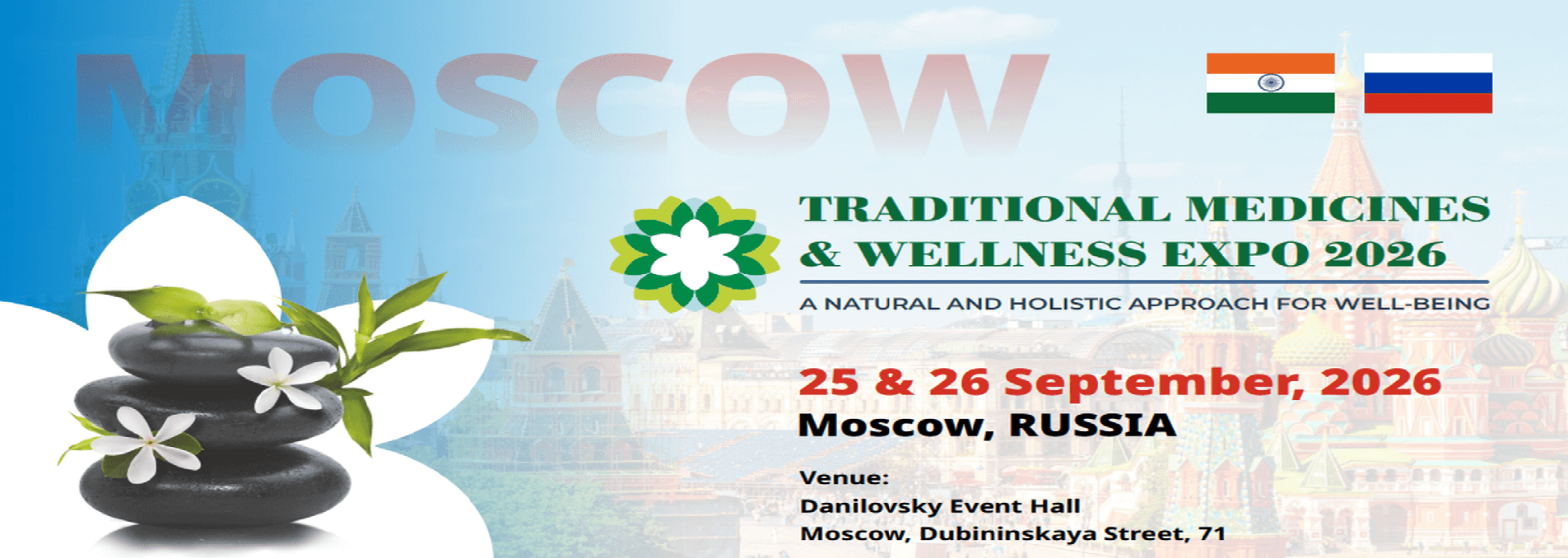
Why Attend Traditional Medicines &
Wellness Expo 2026 - Moscow, Russia?
The Ayurveda & wellness market in Russia is small but expanding rapidly. It’s dominated by imported Ayurvedic supplements and wellness products, with growing consumer interest and distribution through pharmacies, specialty stores, and wellness retreats. Historical interest, academia, and some professional services underpin its credibility. Import pathways and third-party manufacturing options suggest further potential for market entry and expansion.
Waiting for an active participation, to promote exports and to increase India’s share in Ayurveda and Wellness in EURASIA.
Exhibitor Profile
Unani & Siddha
Medicines
Herbal Products
Extracts & Ingredients
Herb and Spices
Condiments
Natural & Organic
Products
Health & Wellness
Supplements
Medicinal Plant
Growers
Exporters &
Direct Sellers
Oral Hygiene
Skin Hygiene
Aroma Essential Oils
Fragrance
Manufacturers
Ayurveda &
Spiritual Wellness
Anti Ageing Detox
Slimming and
Lifestyle Products
Visitor Profile
- Manufacturers
- Buyers
- Traders
- Distributors
- Key decision makers from local government / regulators
- Information on licence / sales etc
- Suppliers etc

Attractions
- Information on license & sales - registration desk
- Dealer & distribution network
- Regulatory and departmental meetings
- Promotion of wellness tourism
- Wellness therapies by renowned practitioners
Why Russia?
An up-to-date view of the Ayurveda and Wellness market in Russia as of 2025:
Market Size & Growth
- The Ayurvedic products market in Russia is estimated at around USD540.5 million in 2024, with a projected 10.7% CAGR in the forecast period.
- This positions it as a mid-sized but fast-growing segment within the health and wellness space.
Products, Distribution & Regulation
- Ayurveda in Russia operates largely through imported supplements and products, not as a distinct regulatory categoryAyurvedic items are treated under general supplement/drug classifications.
- Brands like Liv-52, Cystone, Speman (by Himalaya), Herbion’s cough remedies, Dr.Mom, and others are already established, with average sales growth around 25% per year.
- Imports into Russia are overwhelmingly sourced from India, with India accounting for virtually all shipment volume (15,231 Ayurvedic product shipments), while Thailand and Sri Lanka play a minor role.
Historical Development & Institutional Support
- Interest in Ayurveda in Russia began to take off after the Chernobyl disaster. Since the late 1980s, there’s been steady development, including academic interest and establishment of Ayurvedic centers.
- In the early 2000s, the company Ayurveda Plus introduced several Ayurvedic products (e.g., Triphala Guggulu, Arjuna) and conducted over 30 clinical trials across areas like surgery, psychiatry, geriatrics, and gynecology. It also organized professional training and international conferences to foster integration with conventional medicine.
Market Activities & Commercial Channels
- Third-party manufacturing: There are opportunities for international brands to have Ayurvedic products manufactured for them (often in India) and labeled for the Russian market, leveraging expertise in regulatory documentation and localization.
- Wellness centers: Though fewer in number than in India, there are specialized wellness retreats or centers in Russia that offer Ayurvedic treatments (such as Panchakarma), catering to health-conscious and affluent clientele.
Target Countries
ARMENIA
BELARUS
EGYPT
GEORGIA
HUNGARY
INDONESIA
KAZAKHSTAN
KYRGYSTAN
MIDDLE EAST
MOROCCO
RUSSIA
THAILAND
TURKEY
UZBEKISTAN
VIETNAM

Travel Partner - Russia
InterQuest Travel & Events
Mondeep Chakraborty
mondeep@interquesttravel.com +91 9716028592Nikhil Pandey
nikhil@interquesttravel.com +91 9899863357For inquiries, please contact
For Kazakhstan, Armenia, Belarus Russia and Kyrgyzstan:
Ms. Olesya
consult@sn-mg.kzMs. Julia
marketing@sn-mg.kzFor Uzbekistan, Tajikistan, Turkmenistan, Georgia, China:
Mr. Bunyod Mamajonov
+998 977550013Mr. Davron
+998 933178334 davron-quality@mail.ru